
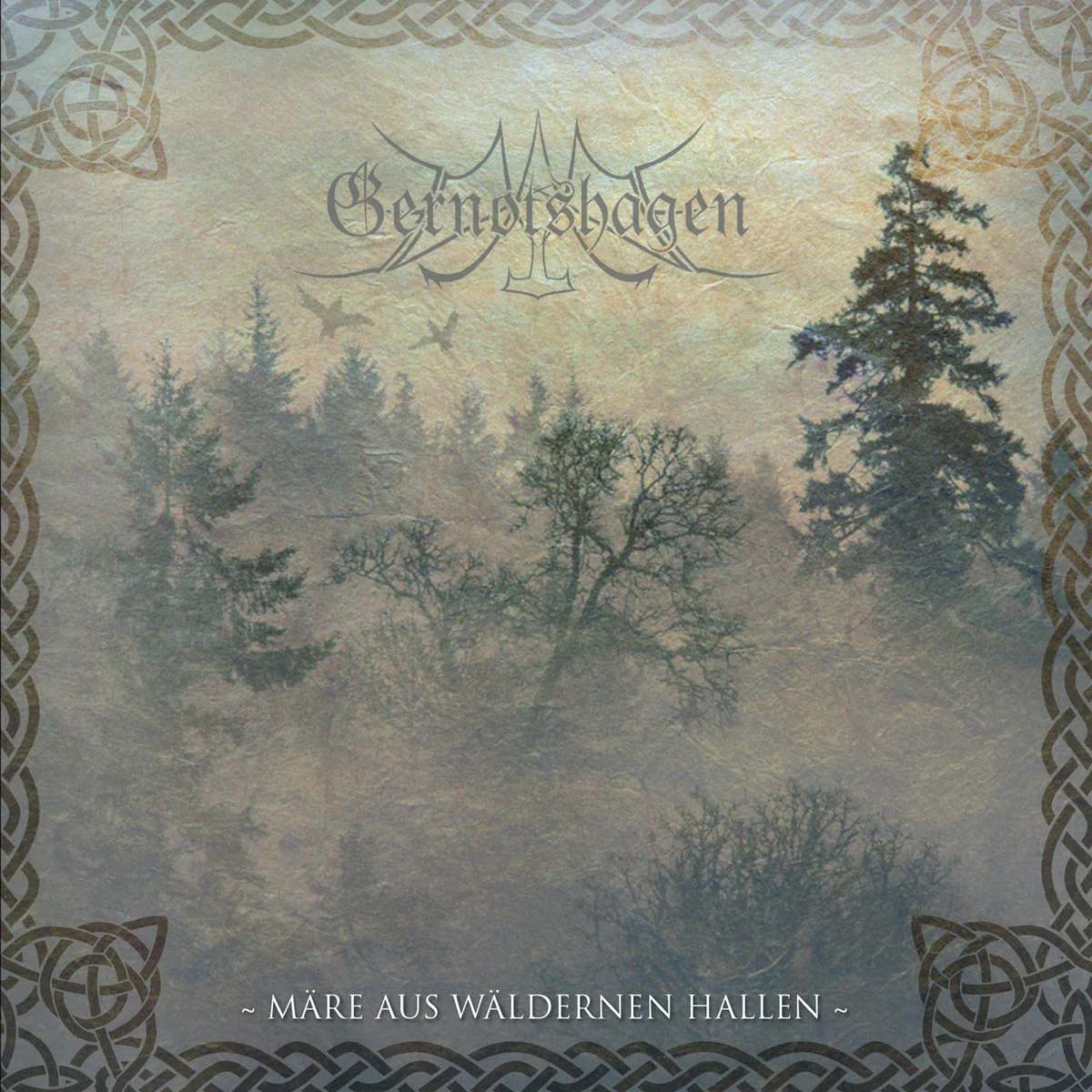
Märe aus wäldernen Hallen
Runagaldr score

A rough-edged but deeply atmospheric pagan black metal album whose dated synths, varied vocals and long-form songwriting still make its mystical forest world work.
Märe aus wäldernen Hallen is exactly the kind of album that makes pagan metal easy to love and easy to mock. There are forests, ancestors, gods, mead, theatrical clean vocals, piercing screams and keyboards that sound very much like they came from the mid-2000s. If that entire sentence makes you cringe, Gernotshagen are probably not going to convert you. If it sounds inviting, this album still has a lot to offer.
What has always worked for me is the atmosphere. The title track opens with synths, acoustic guitar and clean singing, gradually builds toward a final scream, then falls away into “Der alte Wald.” It is less a conventional song than a three-minute entrance into the record, and it does its job perfectly. The synths sound cheap by modern standards, but I cannot bring myself to hold that against them. This was a normal part of the genre’s vocabulary in 2007, and now that sound carries its own DIY charm. If a brand-new band used the exact same patches in 2026, I might have a very different reaction. Here, they belong.
“Der alte Wald” is one of my favorites because it shows how much Gernotshagen can do without ever leaving their niche. Electric guitars and synths give way almost immediately to acoustic and clean guitars before the screams arrive. There are theatrical spoken vocals, lower growls, a slower middle section, and a synth solo whose tone I still absolutely love before it transitions beautifully into a guitar solo. At more than seven minutes, the song takes its time, but it never feels aimless. It breathes.
The vocals are probably the album’s biggest dividing line. Askan’s high screams are piercing, abrasive and sometimes downright hostile. I love them. The low growls are rougher and not necessarily impressive in a technical sense, but they have personality. The clean singing is its own acquired taste again: distinctive, theatrical and very much part of the album’s identity. Gernotshagen themselves were consciously expanding that side of the music here. During the recording sessions, H. Gerull of fellow Thuringian pagan metal band Menhir advised Askan, and the band later said that entire vocal passages in “Der alte Wald” and “Dem Skirnir zu Ehren” were reworked to include clean singing and choirs.
That context makes “Dem Skirnir zu Ehren” especially fun. It opens with a scream held for roughly thirteen seconds and eventually reaches the wonderfully earnest chorus, “Hebt an das Horn gefüllt mit Met…” delivered in low growls. As a German speaker, I cannot pretend it does not sound a little goofy. I also cannot pretend I do not love it. That is pagan metal in miniature: completely ridiculous if you are not on its wavelength, strangely glorious if you are. The final chorus switches to clean vocals and suddenly the same words sound much less silly and more genuinely anthemic.
The album is dynamic, but it is also remarkably consistent. Guitars, acoustics, bass and drums are solid throughout; the keyboards keep supplying that unmistakable old pagan-metal atmosphere; and the songs keep rearranging the same core ingredients rather than reinventing the band every five minutes. That means this does not need a full track-by-track autopsy. If you like one representative song, chances are good that you will understand what the whole record is offering.
There are still individual moments worth singling out. “Widars Klagesturm” opens with chugging guitars, melodic leads and clean vocals, leaning more heavily into melody and lower-register singing. “Dragadhrond,” my other favorite, pulls hard in the opposite direction. It is more scream-oriented and around 2:40 Askan’s high voice becomes so abrasive that it almost dissolves into white noise. The track then ends with a blastbeat, one of the first moments where the album’s black-metal side really lets itself off the leash. It is nasty, memorable and exactly the kind of thing I come to this band for.
That shift is interesting because the album’s second half generally feels blacker and more aggressive. The band said in a 2007 interview that the later songs were generally older and closer to the darker character of Wintermythen, while much of the first half contained newer material. You can hear that history in the sequencing. Blastbeats become more prominent in “Dragadhrond,” “Schlachtensang der Einherjer” and “Vali,” while the newer material tends to spend more time with clean vocals, melody and atmosphere.
“In Gedanken schon Walküren nah” works as a useful pause between those worlds. It is essentially a short synth instrumental, a breather after “Dragadhrond” before the nearly nine-minute “Schlachtensang der Einherjer.” That song is probably the album’s biggest single statement. It throws in all three vocal approaches, soaring leads, galloping and machine-gun rhythm guitars, blastbeats, synths and riffs, then stops for an atmospheric section of piano, keyboards and howling wind that lasts around two and a half minutes. Around the six-minute mark the guitars begin rebuilding the song, but the vocals do not return until roughly 7:12. Some listeners will absolutely think that is too long. I don’t. The scale works for me, and the return to the chorus feels earned because the song makes you wait for it.
“Vali” keeps the blastbeats coming and ends with another wonderfully excessive detail: a guitar lead with a scream sustained for roughly twenty-five seconds over it. Somehow nobody is building a mythology around that scream, but it deserves at least a footnote.
The production is where I have more reservations. I listened to the current Spotify version, and it sounds noticeably rougher than I remembered. I do not want to claim the original CD sounds different without comparing them directly, but this digital version is not especially flattering. The mix can feel thin and uneven, and some of the roughness goes beyond charming old synth patches. There is context for that too: the album was recorded, mixed and mastered in-house, and the band openly discussed learning the process themselves and struggling especially with the drum sound. I appreciate the character, but I would be lying if I called it a great-sounding record.
That roughness matters much less than the songwriting. Even with several long tracks, the album moves quickly. The main weakness only starts showing near the end, where consistency turns into repetition. “Skaid” is good, but by that point it feels like more of what the album has already done rather than one last fresh idea. Its piano interlude and short clean-guitar lead are nice, but the final two minutes are basically waves crashing on the shore and fading out. Atmospheric? Absolutely. Necessary as part of an eight-minute song? Not really. I would much rather those waves had been separated into an outro track, especially remembering the MP3-player era when a two-minute ambient tail meant either pulling the player out of your pocket to skip it or trimming the file yourself.
That is ultimately why this lands at an 8 rather than higher. Märe aus wäldernen Hallen is a fantastic pagan black metal album with a strong identity, genuinely great moments and an atmosphere it sustains remarkably well for more than fifty minutes. It is rough around the edges, the production is imperfect, and the final stretch could use a few more new ideas. It is also absolutely not for everybody.
But for the people who hear cheap synths, shrieking vocals, acoustic guitars, blastbeats, pagan gods and mead and think, “Yes, more of that please,” Gernotshagen built a damn good forest to get lost in.
8/10.